 Haris Odobasic
In short, nine RevOps leaders told me to learn the whole revenue engine, get the data foundation right, and invest in communication and change management. Then tie everything you do to business outcomes, because that is what turns RevOps work into a RevOps career.
Demand for RevOps has been building for years. In January 2023, LinkedIn ranked Head of Revenue Operations first on its list of the fastest-growing roles, based on job titles posted from 2018 to 2022. In October 2026, RevOps Roles counted 8,278 US RevOps job postings that disclosed pay. RevOps is one of my passions, and so I am happy to see that this community is growing.
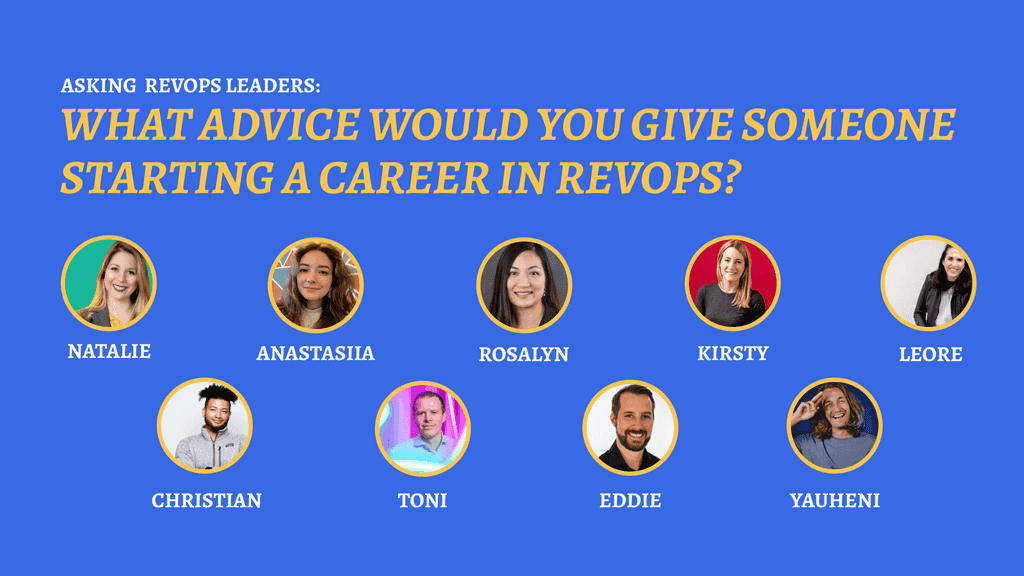
I interviewed 9 RevOps leaders and asked each of them what advice they would give someone starting a career in RevOps.
These revenue leaders collectively have over 50 years of RevOps experience. They've worked at companies such as HubSpot, Salesforce, and Clari, and have advised numerous organizations with their RevOps expertise. I hope you can learn as much from them about RevOps as I have. Job titles below are as they were when we spoke in 2023.
RevOps covers the full revenue engine, not only sales
Despite this being (typically) the start of your journey, Sales is not everything. Sales is "just" the last touch before it hits revenue.
Toni Hohlbein, CEO at Growblocks
Many people start their career in RevOps coming from Sales Operations. It is easy to only focus on sales. But like Toni said, RevOps takes a holistic view on revenue. He ends with a point worth remembering.
If you know & understand the full engine from "traffic to churn", you will likely be the only one in your company. This is a massive superpower that will get you promoted.
Start your RevOps career with CRM database design
In RevOps we work with many tools, data and analytics. This is powerful, but to make this work you need to have a good understanding of database design.
I wish I knew that I would spend more time on database design than anything else. When the database model is right everything else (reporting, analytical projects, forecasting, GTM motion changes, process changes) requires a lot less effort.
Anastasiia Binns, Head of RevOps at N.Rich
You can read more about this topic in my blog on the role of CRM database design for revenue growth.
Expect resistance to change in RevOps
We often try to come up with a better way of doing things. Generally, in RevOps we are innovators. However, the right solution is only one part of it.
The emotional attachment people have to the technologies and processes they know, even if they are not the best for the business or revenue operations. The majority of people resist change. Going in all guns blazing and forcing change fast is rarely the best way to approach revenue operations - even if you know the change will be for the best.
Natalie Furness, CRO at RevOps Automated
Change is not easy, and sometimes the job can be quite frustrating. Christian Freese, CEO and Founder at RevPal, compares working in RevOps to being a nurse. You keep the lights on and do everything you can, and you still take the blame when something goes wrong.
Change management and communication skills in RevOps
Change management and communication are two of the most important skills needed for success in RevOps leadership. There's no point producing a best in class tool or process if it's not going to be properly adopted due to poor internal communication or change management. This applies to communication upwards to leadership as well as to the GTM teams.
Kirsty Charlton, Co-Founder at UK Revenue Operations Network
We in RevOps tend to have a more technical background, which is very helpful for our line of work. At the same time, we have to work with stakeholders across the whole revenue organization. We need to be good communicators or else we can't be effective. My tip would be to invest your learning budget in communication classes and change management classes.
It will pay off. Leore Spira, Adv., Head of RevOps at Buildots, says much the same thing.
The intricacies of change management present both challenging and empowering experiences, sometimes leading to frustration, yet at other times fostering growth and resilience.
How to be proactive and strategic in RevOps
Focus on the 5 Whys and ask yourself "So what?" to get to the heart of the issue. RevOps is far too reactive today. Dig deep to understand what is really driving revenue and what could drive revenue. Ask why your CRO, CMO, CEO should care. Your impact and exposure to the leadership team will grow exponentially.
Eddie Reynolds, CEO at Union Square Consulting
The key here is really to connect the operational details to business outcomes. Here your soft skills are becoming more important.
It's strong people skills, ability to listen and emotional intelligence. Effective, frequent and clear communication will help you find alignment among various stakeholders. Focusing on understanding the deeper needs and drivers of your stakeholders is what truly advances you in this career track.
Yauheni (Eugene) Bankouski, Co-Founder at Revenue Wizards
Communicate your RevOps impact in business metrics
Effectively asserting dissent with management or leadership can be arduous, but when executed strategically and tactfully, it garners admiration and respect for RevOps.
In RevOps you will often struggle with technical details that might take days of work. The thing is, nobody really cares about these technical details. Don't get me wrong, your work is important, but you have to communicate the impact in terms of business metrics. That is what will make you a revenue leader.
I wish I knew earlier that we need to highlight our impact and value to the business. Oftentimes, as Ops professionals, we work diligently and incorrectly believe that our efforts will show for themselves. The reality is that we need to be intentional about communicating the value we bring.
Rosalyn Santa Elena, Founder at The RevOps Collective
If you already lead a revenue team and want to make RevOps strategic in your company, our executive workshops are one way to start that conversation.
A 30-60-90 day plan for your first RevOps role
The advice above holds up. Here is how we would turn it into a first 90 days in a RevOps role in 2026, based on our Five Dots methodology and what we see in client teams.
In our client work, RevOps often exists as a label before it exists as a capability, which usually means an admin-heavy team, scattered ownership and a lot of manual CRM work. The people who stand out are the ones who turn that into documented processes, clean data and clear ownership.
- In days 1 to 30, learn the whole engine. Map the revenue process from first touch to renewal, including the stages, their definitions, the handoffs and who owns each one. Read the CRM data model and list the fields your key reports depend on.
- In days 31 to 60, go deep on one pillar. RevOps rests on four pillars, namely enablement, process, systems, and data and insights. Pick the one closest to your strengths, fix one recurring problem end to end and write down how you did it.
- In days 61 to 90, show the result in business terms. Translate that fix into a metric leadership cares about, such as pipeline, win rate, bookings or ARR, and offer to co-own an OKR with the team whose number it moves.
- Build AI and communication habits the whole time. Automate one defined reporting task with proper checks, then work towards designing multi-step automations with error handling. And ask for a communication or leadership coach as soon as you lead anyone.
Hiring managers know one more thing. A company's first RevOps hire should be a senior generalist, an "analytical people wrangler" who covers all four pillars and brings people along. Early in your career, you usually get there by entering through an adjacent role, such as sales ops, marketing ops, CRM admin or enablement, mastering one pillar and then widening out. Our overview of the traits and skills of top RevOps professionals shows what that profile looks like.
Resources for moving into a RevOps career
See what RevOps roles pay by level, location and company size with our RevOps salary calculator. If you want a structured way to learn, RevOps Essentials is the course we built for career switchers and future RevOps leaders. And for new playbooks and research by email, subscribe to the GrowthTrack newsletter.
Frequently asked questions about starting a RevOps career
How do I get into RevOps with no RevOps experience?
Start in an adjacent role, such as sales ops, marketing ops, CRM admin or enablement, and volunteer for cross-team process and data work. Learn the full revenue engine, go deep on one pillar and document what you fix; that evidence matters more than a title.
What does a junior RevOps role pay?
In RevOps Roles' October 2026 data, US junior RevOps roles show a median pay range of $60k to $80k, and roles asking for 0 to 2 years of experience show $75k to $102k. Pay rises steeply with experience, and Director roles sit at $171k to $239k.
Is RevOps a good career in 2026?
Yes, for people who like systems and people in equal measure. Demand is well established. LinkedIn named Head of Revenue Operations the fastest-growing role in 2023, RevOps Roles counted 8,278 US RevOps postings with published pay in October 2026, and postings that ask for AI skills pay about 11% more. The work is shifting from building reports to designing the processes and data that AI runs on.
Which skills should I learn first?
Learn the CRM data model and database design first, then communication and change management. In 2026, add AI workflow building. Start by automating a defined reporting task with checks, then move on to multi-step automations.
Do I need a certification to work in RevOps?
No. A course can shorten the learning curve, but hiring managers look for evidence that you can do the work, such as a documented process, a cleaner report or a working automation. Our comparison of RevOps courses explains which certification fits which starting point.