
GTM Engineer vs Revenue Operations (RevOps): What Is the Difference?
GTM engineer and RevOps are not the same thing. One is a job title. The other is a function. Here is the difference - and who to hire first.

Haris Odobasic
Revenue Operations vs Go-to-Market Engineering: What's the Difference?
People use these two terms as if they're interchangeable. They aren't, and the difference matters when you're deciding who to hire.
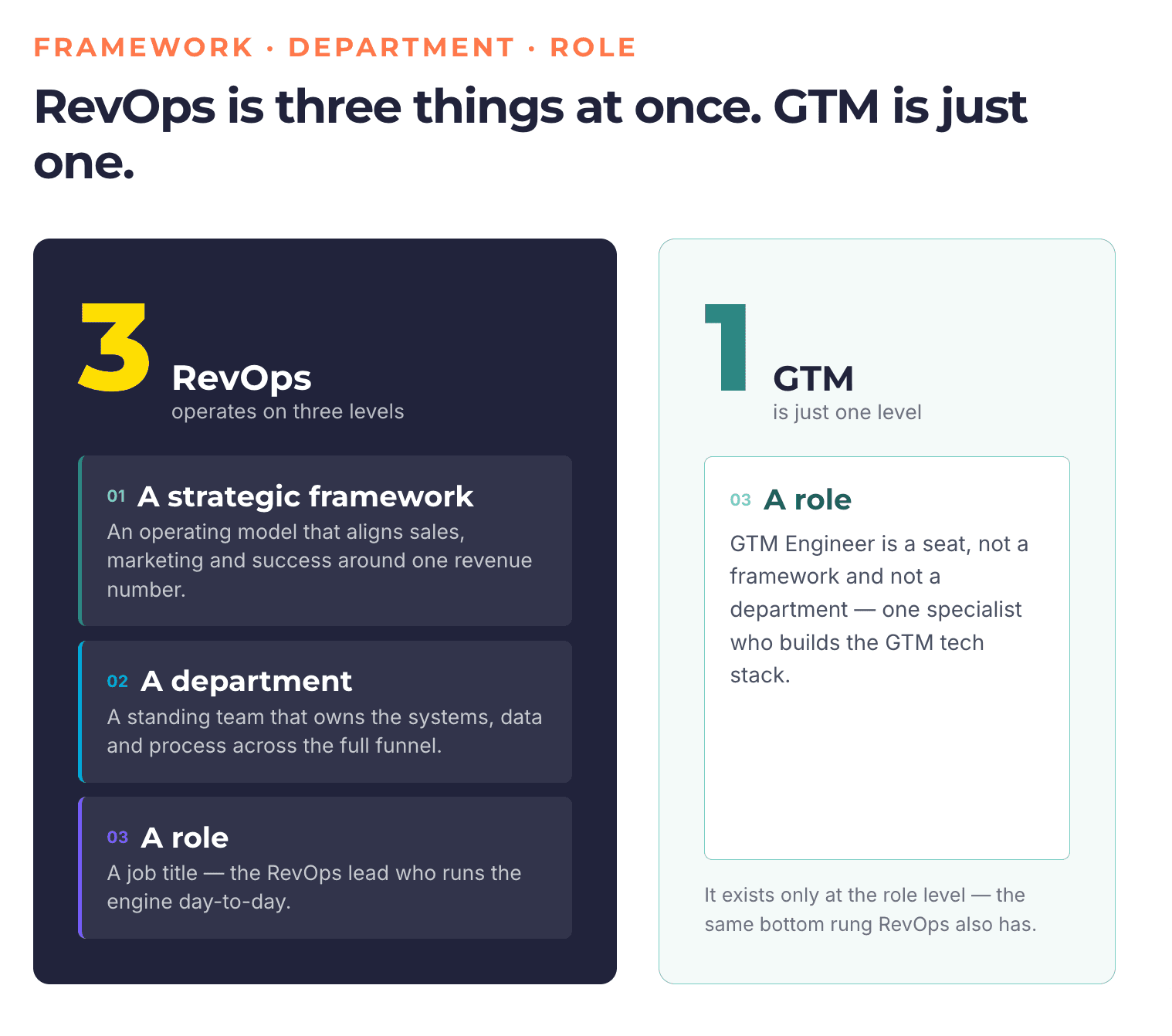
Revenue Operations (RevOps) is three things at once: a strategic framework, a department, and a job role. Go-to-Market Engineering is one thing: a job title with a specific set of tasks.
Where Go-to-Market Engineering came from
The term is recent. Clay coined GTM Engineering in 2023, in an internal Slack discussion about how to describe the AI-meets-automation work their team was doing, then built a whole ecosystem around it to position the company and its product (Next Play, First Round Review). That's not a knock. It was a smart category creation. But it's worth knowing the term was built to sell something.
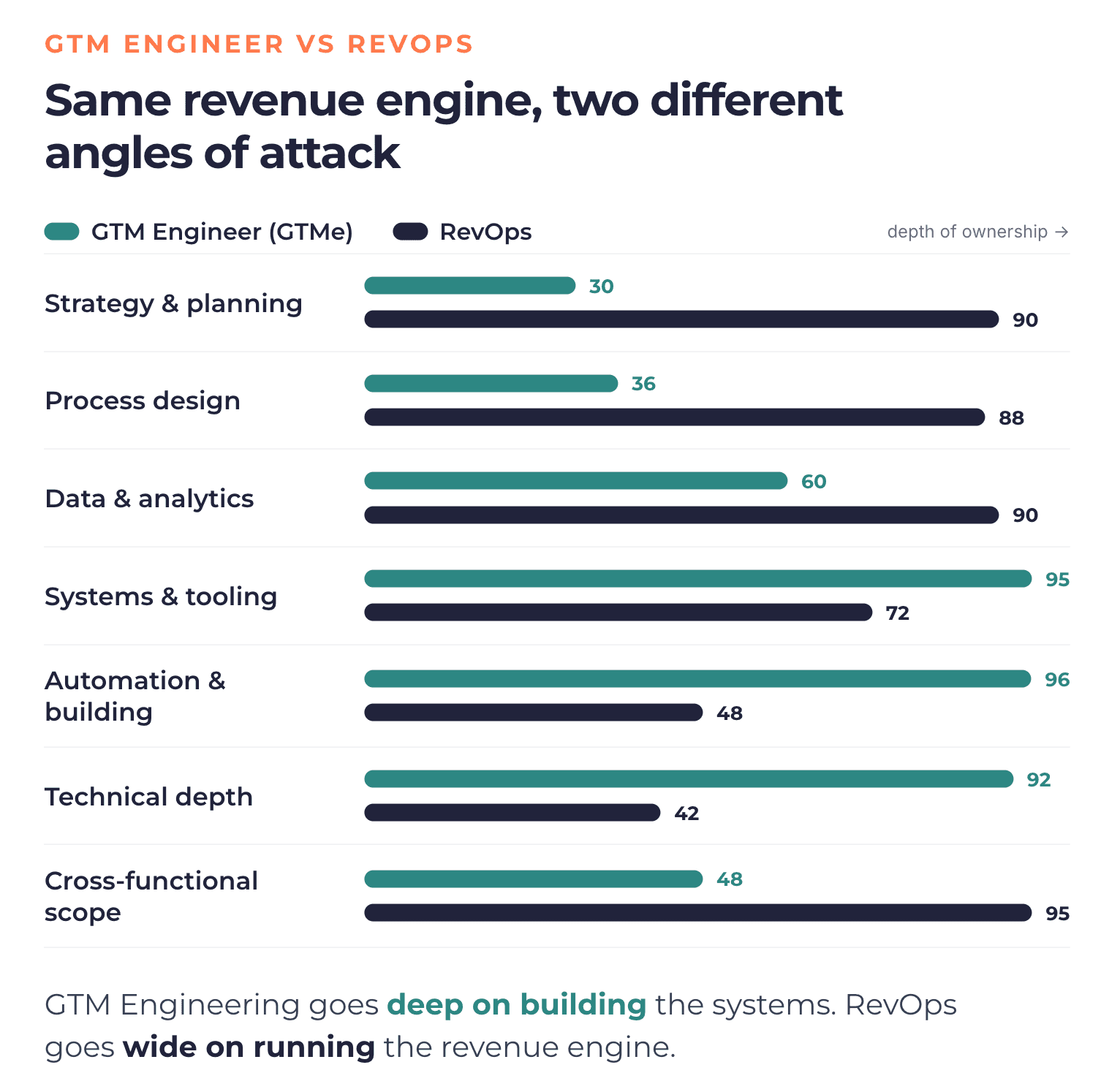
A go-to-market engineer builds technical solutions using AI data enrichment and workflow automation. The work is data foundation, data modelling, and data activation. It's a technical role, and it usually sits inside the RevOps function.
RevOps as a framework
As a strategic framework, the goal of RevOps is to build a revenue system through revenue architecture: aligning the business at the strategy, process, data, and technology level. It's strategic and operational at the same time. That's the part the GTM engineer title leaves out.
RevOps as a department
As a department, RevOps is a support function for the commercial teams. That's marketing, sales, and customer success. It also aligns with finance, legal, and product. Anything that touches commercial.
Inside the department, the focus areas are usually:
Strategy
Process
Enablement
Data and analytics
Technology
And the roles you'll find across those areas:
A VP of Revenue Operations who heads the department
Cross-functional leads who create alignment
Sales ops, CS ops, and marketing ops people
Automation specialists
AI operations
People for data modelling
A GTM engineer
It depends on your internal structure. Your current team can cover a lot of this already. It comes down to a choice: label someone a GTM engineer, or split the work across the teams you have.
Who to hire first
In most cases your first hire should be a RevOps person, not a GTM engineer.
RevOps understands the business, the process, and the operational side. That link is what builds a coherent system. You need both skills, strategic and operational. A GTM engineer is heavy on the technical side. The risk there is that you build systems nobody uses. You need the commercial thinker in the room.
So your first hire is usually a generalist, leaning strategic. Then you complement the team with the technical people: a CRM admin, a go-to-market engineer, and so on.
Not every team has that role in-house, and at Series A or B most can't justify the hire. Some bring it in fractionally instead. Firms like The GTM Engineering Company embed inside a client's existing CRM, building Clay enrichment, AI scoring and signal-based outbound in weekly sessions with the in-house RevOps team, then documenting each workflow so the team can run it afterwards. The engagement is temporary. The system isn't. It fits VC-backed B2B SaaS between $1M and $30M ARR.
Build the thinking first. Add the wiring after.
Revenue Operations vs Go-to-Market Engineering: What's the Difference?
People use these two terms as if they're interchangeable. They aren't, and the difference matters when you're deciding who to hire.
Revenue Operations (RevOps) is three things at once: a strategic framework, a department, and a job role. Go-to-Market Engineering is one thing: a job title with a specific set of tasks.
Where Go-to-Market Engineering came from
The term is recent. Clay coined GTM Engineering in 2023, in an internal Slack discussion about how to describe the AI-meets-automation work their team was doing, then built a whole ecosystem around it to position the company and its product (Next Play, First Round Review). That's not a knock. It was a smart category creation. But it's worth knowing the term was built to sell something.
A go-to-market engineer builds technical solutions using AI data enrichment and workflow automation. The work is data foundation, data modelling, and data activation. It's a technical role, and it usually sits inside the RevOps function.
RevOps as a framework
As a strategic framework, the goal of RevOps is to build a revenue system through revenue architecture: aligning the business at the strategy, process, data, and technology level. It's strategic and operational at the same time. That's the part the GTM engineer title leaves out.
RevOps as a department
As a department, RevOps is a support function for the commercial teams. That's marketing, sales, and customer success. It also aligns with finance, legal, and product. Anything that touches commercial.
Inside the department, the focus areas are usually:
Strategy
Process
Enablement
Data and analytics
Technology
And the roles you'll find across those areas:
A VP of Revenue Operations who heads the department
Cross-functional leads who create alignment
Sales ops, CS ops, and marketing ops people
Automation specialists
AI operations
People for data modelling
A GTM engineer
It depends on your internal structure. Your current team can cover a lot of this already. It comes down to a choice: label someone a GTM engineer, or split the work across the teams you have.
Who to hire first
In most cases your first hire should be a RevOps person, not a GTM engineer.
RevOps understands the business, the process, and the operational side. That link is what builds a coherent system. You need both skills, strategic and operational. A GTM engineer is heavy on the technical side. The risk there is that you build systems nobody uses. You need the commercial thinker in the room.
So your first hire is usually a generalist, leaning strategic. Then you complement the team with the technical people: a CRM admin, a go-to-market engineer, and so on.
Not every team has that role in-house, and at Series A or B most can't justify the hire. Some bring it in fractionally instead. Firms like The GTM Engineering Company embed inside a client's existing CRM, building Clay enrichment, AI scoring and signal-based outbound in weekly sessions with the in-house RevOps team, then documenting each workflow so the team can run it afterwards. The engagement is temporary. The system isn't. It fits VC-backed B2B SaaS between $1M and $30M ARR.
Build the thinking first. Add the wiring after.
Revenue Operations vs Go-to-Market Engineering: What's the Difference?
People use these two terms as if they're interchangeable. They aren't, and the difference matters when you're deciding who to hire.
Revenue Operations (RevOps) is three things at once: a strategic framework, a department, and a job role. Go-to-Market Engineering is one thing: a job title with a specific set of tasks.
Where Go-to-Market Engineering came from
The term is recent. Clay coined GTM Engineering in 2023, in an internal Slack discussion about how to describe the AI-meets-automation work their team was doing, then built a whole ecosystem around it to position the company and its product (Next Play, First Round Review). That's not a knock. It was a smart category creation. But it's worth knowing the term was built to sell something.
A go-to-market engineer builds technical solutions using AI data enrichment and workflow automation. The work is data foundation, data modelling, and data activation. It's a technical role, and it usually sits inside the RevOps function.
RevOps as a framework
As a strategic framework, the goal of RevOps is to build a revenue system through revenue architecture: aligning the business at the strategy, process, data, and technology level. It's strategic and operational at the same time. That's the part the GTM engineer title leaves out.
RevOps as a department
As a department, RevOps is a support function for the commercial teams. That's marketing, sales, and customer success. It also aligns with finance, legal, and product. Anything that touches commercial.
Inside the department, the focus areas are usually:
Strategy
Process
Enablement
Data and analytics
Technology
And the roles you'll find across those areas:
A VP of Revenue Operations who heads the department
Cross-functional leads who create alignment
Sales ops, CS ops, and marketing ops people
Automation specialists
AI operations
People for data modelling
A GTM engineer
It depends on your internal structure. Your current team can cover a lot of this already. It comes down to a choice: label someone a GTM engineer, or split the work across the teams you have.
Who to hire first
In most cases your first hire should be a RevOps person, not a GTM engineer.
RevOps understands the business, the process, and the operational side. That link is what builds a coherent system. You need both skills, strategic and operational. A GTM engineer is heavy on the technical side. The risk there is that you build systems nobody uses. You need the commercial thinker in the room.
So your first hire is usually a generalist, leaning strategic. Then you complement the team with the technical people: a CRM admin, a go-to-market engineer, and so on.
Not every team has that role in-house, and at Series A or B most can't justify the hire. Some bring it in fractionally instead. Firms like The GTM Engineering Company embed inside a client's existing CRM, building Clay enrichment, AI scoring and signal-based outbound in weekly sessions with the in-house RevOps team, then documenting each workflow so the team can run it afterwards. The engagement is temporary. The system isn't. It fits VC-backed B2B SaaS between $1M and $30M ARR.
Build the thinking first. Add the wiring after.
Stay updated with our Revenue Blog
Stay updated with our Revenue Blog
View all Posts

When ARR Reporting Breaks: The Case For Custom Snapshot
Sep 28, 2026
Why CRM-native ARR reporting breaks on multi-year deals, and how a custom snapshot layer gives you an ARR waterfall finance can actually trust.

AI Pricing Models: The Hidden Cost of Credit-Based Billing
Sep 18, 2026
How AI pricing models really work, why credit-based billing is hard to forecast, and what buyers should demand before they sign.

7 Best B2B SaaS Marketing Agencies for Pipeline (2026)
Jun 1, 2026
The 7 best B2B SaaS marketing agencies in 2026, with real pricing, honest limitations, and a straight answer on which part of your revenue engine each one actually fixes.
Load More


Book a call
Choose a time
