 Haris Odobasic
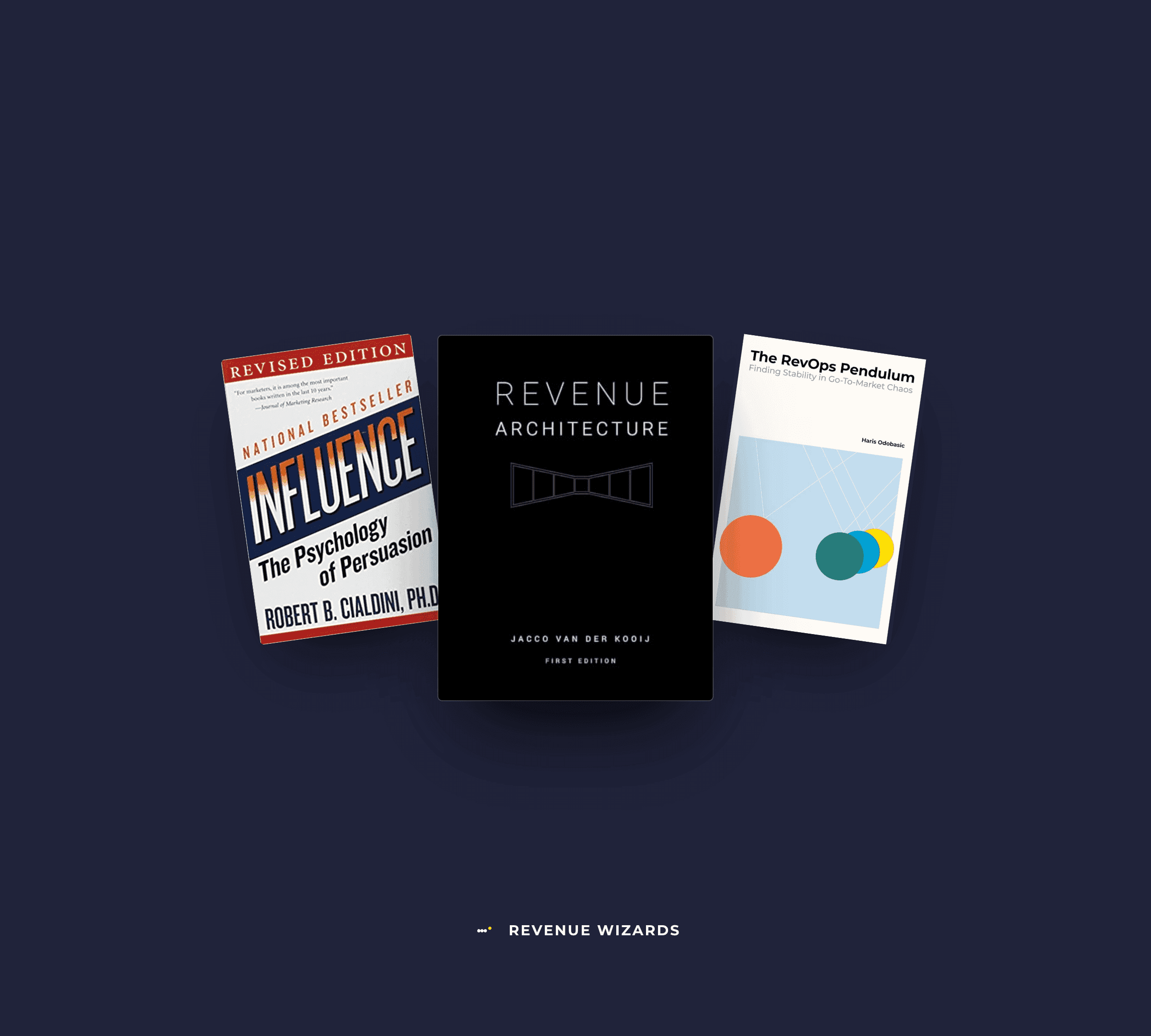
The three best revenue operations books are Revenue Architecture by Jacco van der Kooij, The RevOps Pendulum by Haris Odobasic and Influence by Robert Cialdini. Read them as a set, with one for the revenue system, one for building the RevOps function and one for the change management that makes either of them work.
In the interest of full disclosure, The RevOps Pendulum is our own book, written by the author of this post.
Reading for a team? Training one person is cheap. Fixing the system they will work in is not. If you are building RevOps for a team, start with a fixed-scope check of CRM data, process and tools. Our CRM and GTM Health Check ranks the gaps and fixes the first one. If your leadership team first needs to agree on what RevOps should deliver, start with our half-day executive workshop.
Why three books are enough
I have read over 500 books in the last 10 years, and the one lesson I learned is not to waste your time on a bad book. You will find many listicles that only show you the top 13, 20, or even 50 books. The truth is you will be fine with three revenue operations books on most subjects. Less is, as always, more.
It is more important that you apply what you read in the books. I made that mistake myself. At some point, I was just reading for the sake of reading. Consuming audiobooks while cycling, reading before and after work. What did I apply? Not much. It was still a good experience, and I learned a thing or two. But when it comes to applicable skills like communication, leadership, or revenue operations, you need to apply it. A book can give you directions. It's up to you to execute.
The three books we will look at are Revenue Architecture, The RevOps Pendulum, and Influence: The Psychology of Persuasion. For each one you will find who it is for and one practical next step.
Revenue Architecture, Jacco van der Kooij
Jacco has been in the go-to-market domain for many decades. He and his team at Winning by Design have worked with hundreds of SaaS companies and taught thousands more through their trainings. Revenue Architecture is the result of all that work. It's no surprise the book is over 500 pages. Yet all the pages are worth it.
Revenue Architecture gives you the blueprints to build a revenue system. Having a revenue system is a necessity to deploy AI in your business, and our own 2026 survey of 123 RevOps practitioners shows why. Of those practitioners, 73% have an AI mandate, but only 38% have the data to support it. The definition of a system is that it is connected from front to end. In go-to-market teams, that means from the top of the funnel all the way down to invoicing and retaining customers. Revenue Architecture covers it all.
Yet the reality is that most businesses function with isolated departments, decision paralysis, and a playbook that may have worked in the 2010s. Sad.
Anyone who is serious about setting up a revenue system in their business should read Revenue Architecture.
- Read it if you are a founder, CRO or RevOps leader who designs or redesigns the revenue system.
- Then check your CRM. The book grounds decisions in standardized data models, so before you redesign anything, find out whether your CRM can support one. Are stage definitions, segmentation fields and renewal dates consistent and filled in? That is also the first thing our CRM and GTM Health Check looks at.
You can read more about Revenue Architecture on the Winning by Design site.
The RevOps Pendulum, Haris Odobasic
The full title is The RevOps Pendulum: Finding Stability in Go-to-Market Chaos. Yes, this is me shamelessly plugging my own book. Now, there is a reason for that. Namely, that I tried to write a really good book. By now you may have noticed that I love books. I read for pleasure, and for growth. A good book is powerful. It can change you, inspire you, and make you dream.
The RevOps Pendulum was my first book, and with it I wanted to create a common understanding of Revenue Operations. I know a few things about RevOps, but not all. Therefore, the book was supported by over 100 experts, the input of 100 coaching sessions, 30+ consulting projects, and four exclusive research studies conducted for the book. My education is in economics, so for me it was important to write something objective.
The book has so far passed the test of time. The principles and techniques you will read in it are still valid. Here are a few of them.
- How to structure a Revenue Operations department
- A deep dive into the four RevOps pillars, which are Enablement, Process, Systems, and Data and Insights
- The importance of a data foundation, especially to deploy AI
- Universal AI fundamentals and the role of RevOps
In short, the book helps you set up revenue operations from scratch, but it also helps you elevate your RevOps department to the next level.
- It is written for RevOps leaders and first RevOps hires who are building or resetting the function.
- Then map your current team against the four pillars and pick the one pillar where a gap costs you most. The free templates that accompany the book, from a target operating model template to a change management toolkit, are linked from the book page.
The templates and everything else about the book are on the book page for The RevOps Pendulum.
Influence, Robert Cialdini
Haris, why do you put a psychology book on a Revenue Operations book list? Because RevOps is all about change management. In our RevOps course, a full module is dedicated to communication and change management, as it is so important to the success of RevOps.
Revenue Operations is about building a revenue system across various departments, ranging from marketing operations and sales operations to product and everything in between. In some projects, I have to coordinate with over 100 stakeholders, and that is not an exception. That those stakeholders come from different departments makes it even more challenging. Not only do they have different priorities, but also different personalities. A lawyer behaves very differently from a marketer, and product management is different from a seller. Yet in Revenue Operations you have to tailor to each of those departments and personalities to have success in your line of work.
Influence by Cialdini is a timeless book about how to influence people (and protect yourself from influence). It helps you become a change agent in your business. It is one of those books I would recommend reading multiple times. Revenue Architecture and The RevOps Pendulum you can read one time and you will get it. But Influence requires you to change your own behaviour before you can change the behaviour of others. You are learning a new skill, and that is hard. Yet you are learning a life skill. It will benefit you in different areas of your life and serve you for a lifetime.
Our client work points the same way. Adoption, not configuration, is the recurring bottleneck. Changes land too fast, processes are unclear and stakeholder input is scattered. That is why our Five Dots methodology treats stakeholder management, communication and change management as decisive skills for the first RevOps hire, and calls strong analytics with weak people skills the classic hiring mistake.
- Anyone in RevOps who has to change how other teams work should read it, and that means everyone in RevOps.
- Then list the stakeholders for the change you are rolling out now and write down, for each, what would make them say yes. Revisit the list after each chapter.
You can get it on Amazon as Influence: The Psychology of Persuasion.
Five more books for the adjacent skills
On most subjects, three books are enough. RevOps touches several neighbouring subjects, so we added one book for each, with the same test, namely who it is for and what to do after you read it.
Revenue Operations, Stephen G. Diorio and Chris K. Hummel
Published by Wiley in April 2022 and based on more than a thousand surveys of and interviews with business professionals, it makes the case for a new way to align sales and marketing and monetize data, and includes an analysis of the sales and marketing technology landscape.
- It suits leaders who have to explain to a CEO or CFO why RevOps deserves budget.
- Afterwards, list the three revenue leaks you can see today, such as slow lead response, inconsistent stage definitions or renewals tracked in a spreadsheet, and the business metric each one moves.
The publisher has a page for Revenue Operations on Wiley.
Predictable Revenue, Aaron Ross and Marylou Tyler
The 2011 classic on outbound prospecting and specialized sales roles, with separate people for prospecting and for closing.
- Read it if you build or run an SDR or BDR team.
- Then write down your SDR-to-AE handoff, meaning which fields must be complete, who owns the lead at each stage and when the clock starts. If any of it lives only in people's heads, fix that before you hire the next rep. Our BDR onboarding and ramp blueprint covers the rest.
You can order Predictable Revenue on Amazon.
The Sales Acceleration Formula, Mark Roberge
Published by Wiley in February 2015, it is Mark Roberge's account of scaling sales at HubSpot with data, technology and inbound selling.
- It is most useful for RevOps people who support sales hiring, onboarding and ramp.
- Next, define three to five observable skills for each sales role, measure new hires against them and treat ramp time as your north-star onboarding metric.
Wiley lists it as The Sales Acceleration Formula on Wiley.
Measure What Matters, John Doerr
The 2018 book on OKRs, the goal-setting framework that runs across functions.
- Pick it up if you lead RevOps and need to show your impact.
- Then take on a shared OKR. RevOps influences nearly every revenue KPI but owns none of them. Co-own one OKR with sales or customer success this quarter, on a lever you can actually move, such as lead response time or forecast accuracy.
The book has its own site, Measure What Matters.
storytelling with data, Cole Nussbaumer Knaflic
A data visualization guide for business professionals, and the most practical book we know on turning a report into a decision.
- Read it if you build dashboards or board slides for leadership.
- Then take the dashboard leadership looks at most and cut it to the few numbers they act on, each with one sentence on what changed and why.
Details are on the storytelling with data books page.
How to read them
That is the list. My suggestion would be to get all three core books in parallel. Skim through Revenue Architecture to the parts relevant to your business. The RevOps Pendulum you can read front to end, but feel free to jump around too. Influence you can read front to end one time before bed. Then re-read it chapter by chapter. After each chapter, spend one week applying what you learned, and only then move on. Good luck.
Not sure which skills to read up on first? Our free RevOps skills gap checklist takes about five minutes and shows your top three gaps. And for new RevOps playbooks and research by email, subscribe to the GrowthTrack newsletter.
Managers, keep in mind that books build understanding while systems build results. If your team is reading these to change how revenue runs, test the ideas against your own CRM first. Training one person is cheap. Fixing the system they will work in is not. Start with a fixed-scope check of CRM data, process and tools, which is what our CRM and GTM Health Check does. It ranks the gaps and fixes the first one.
FAQ
What is the best book for a first RevOps hire?
The RevOps Pendulum is the best fit if you are building the function, because it covers team structure, the four pillars and change management; Revenue Architecture is the better fit if you own the whole revenue system end to end. Add Influence for the people side either way. (The RevOps Pendulum is our own book.)
Is Revenue Architecture worth reading?
Yes, if you design or run a recurring revenue system. At 556 pages it is long, so skim to the parts that match your business rather than reading it cover to cover.
Is there a good book about AI in RevOps?
The RevOps Pendulum has a chapter on AI's role in RevOps and on positioning RevOps as the driver of AI implementation. AI material dates quickly, so pair any book with current data, such as our 2026 survey of 123 RevOps practitioners.
How many RevOps books should I read?
Three on RevOps itself, then one for each adjacent subject you actually need. Applying one book well is worth more than reading five.
Should I read RevOps books or take a course?
Read for depth and take a course for structure and practice; doing both works well. Our comparison of the five best RevOps courses and certifications covers the course side.