
Revenue Operations Org Chart for Mid-Sized SaaS (2026)
One RevOps generalist can't carry it anymore. Here is the revenue operations org chart for mid-sized SaaS that scales your commercial team without adding headcount.

Haris Odobasic
The Revenue Operations (RevOps) Org Chart for 2026
"The best structure will not guarantee results and performance. But the wrong structure is a guarantee of failure." - Peter Drucker
Fast-forward two years from where I left them in the book. MyGym24 - the fictional gym-software company I use to make this stuff tangible - raised a Series A in Berlin-Mitte, and the bet paid off. They raised again. The commercial team went from a handful of people to about thirty-five across sales, marketing, and customer success.
And Maria, their Head of RevOps, is drowning.
She's still the entire RevOps function. One person. She's expected to set strategy, clean the data, own the customer relationship management (CRM) system, design the automation, build the dashboards, run enablement, and - new this year - figure out the AI roadmap. On a good week she does two of those well. The rest slip.
This is the moment the question changes. Early on, the question is "do we even need RevOps?" Past a certain size, it becomes "how do we structure it?" If you have 20 to 50 full-time equivalents (FTE) in your commercial functions, you're at that moment. So let's build the revenue operations org chart.
Why this is harder in 2026
It's harder because of AI, and not in the way most people think.
In our global RevOps survey of 123 practitioners, three-quarters of companies reported an AI mandate from leadership. Only about a third had the data infrastructure to support it. That gap - a mandate without the foundation underneath it - is not a tooling problem you can buy your way out of. It's an org design problem. Someone has to own the data. Someone has to own the systems and the AI on top of them. Someone has to own the process and the people. And those are not the same someone.
Which is the whole point of the revenue operations team structure below.
Start from the pillars
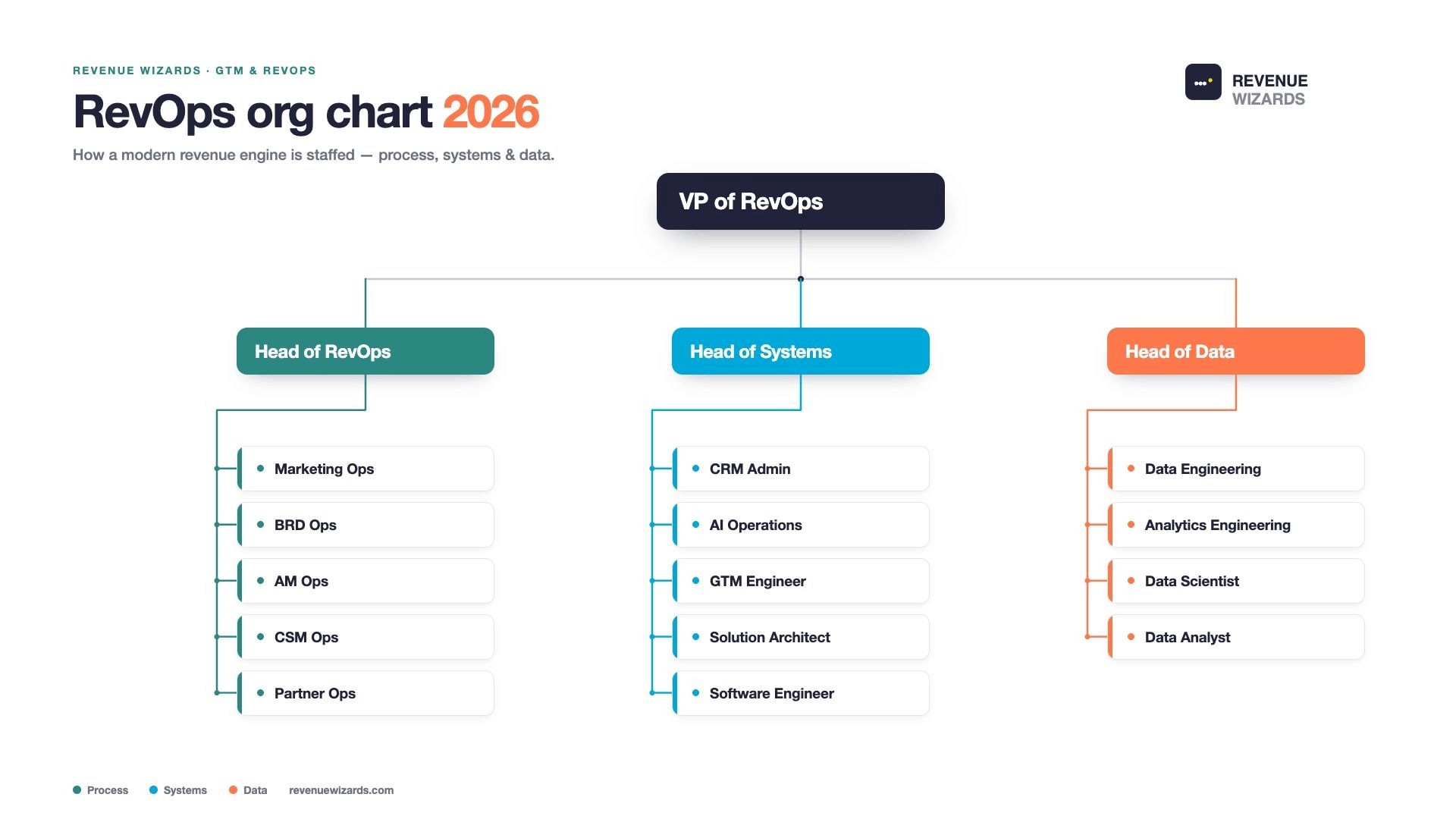
RevOps has four pillars: Data & Insights, Processes, Systems, and Enablement. A good org chart is just those pillars with owners' names on them. Get the pillars right and the boxes draw themselves. Get them wrong - one person holding all four, or enablement floating off on its own - and you get Maria.
Here's how I'd distribute the weight.
Head of RevOps - process and enablement
This is your generalist function, and "generalist" is not an insult. The Head of RevOps manages a team of subject-matter experts - one per domain that actually applies to your business (sales ops, marketing ops, CS ops, partner ops; only the ones you need). Their focus is strategy, process, and enablement.
Enablement - content, training, onboarding - sits here, with the generalists. Not as a standalone hire.
I'll say this plainly, because I've watched it fail every single time: do not hire a pure enablement person with no RevOps skills. They produce decks no one uses and training disconnected from how the process actually runs. Enablement only works when it's attached to someone who understands the system they're enabling people to use.
Key skills for this role: stakeholder management, strategic thinking, communication. This person spends their day with humans and not in the terminal.
Head of Systems - tooling, automation, and AI
This head owns the stack. Reporting into them:
A tooling and automation expert who keeps the systems running and connected.
An AI Operations role that designs AI use cases and manages the AI stack - this is a real job now, not a side project.
A software engineer who builds and maintains custom solutions.
That last one is the part people resist, so let me be direct: in 2026 you are going to build, not just buy. The interesting go-to-market (GTM) advantages aren't sitting in an off-the-shelf tool anymore. And yes, "vibe coding" will get you a prototype over a weekend. It will not get you something your revenue team can run the business on. A prototype that quietly becomes the production system is a liability with a countdown timer. If you're going to build, let a real engineer do it.
This is also where AI in GTM lives. RevOps owns it. From our CRO survey: without RevOps ownership, AI increases noise instead of impact. AI bolted onto a messy system just produces wrong answers faster.
Key skills: highly technical, strong AI focus.
Head of Data - the engine
Data is part of RevOps. Not a favor you ask the central data team for, not a quarterly export. A Head of Data who manages a data team, inside RevOps, reporting into the function.
Why hold this line so firmly? Because data is what will drive revenue - pipeline scoring, churn prediction, capacity models, the inputs every AI use case depends on. Remember the survey: the companies winning with AI are the third that have the data. That third didn't get there by borrowing it when convenient.
Key skills: strong data focus, machine learning (ML) engineering.
VP of RevOps - the pivot
Three heads pulling in three directions isn't a system. It's three departments that happen to share a name.
The VP (Vice President) of RevOps is the pivot point - the thing the whole revenue operations team structure swings around. They orchestrate: data feeds systems, systems serve process, process is what enablement teaches, and all of it points at revenue. Without the pivot, you have weight with nowhere to transfer. With it, the same force moves something far larger than itself.
What this buys you
I recommend this B2B SaaS org chart setup for companies with 20 to 50 FTE in commercial functions. Below that, it's too heavy - you don't need three heads to support fifteen salespeople.
In my client work, a structure like this is what lets a company 3–5x its commercial team without adding a single ops hire. The ops function stops scaling linearly with the sales floor. And the commercial team itself gets materially more efficient - somewhere in the 2-10x range, depending on how broken things were when you started. Those are ranges from what I've seen, not guarantees. The rest is execution.
This is also one viable composition. A company with heavy partner motion, or several geographies at different maturities, will shift the weights around. The principle holds even when the boxes move: distribute the four pillars, give each a real owner, and put a pivot in the middle.
Structure is the skeleton. The harder question - the one I get asked the moment someone sees this chart - is sequencing: when you can't hire all of this at once, who comes first? That's a separate post.
Socratic reflections
How many people are in your ops function today, measured against your commercial headcount? Is the ratio scaling with the sales floor, or independent of it?
Of the four pillars - data, systems, process, enablement - is there one that's currently owned by no one?
If an AI mandate landed on your GTM team tomorrow, who owns the rollout? Do they also own the data it runs on?
Is your enablement sitting with someone who has actually carried a RevOps domain - or with someone producing training in a vacuum?
Who is your pivot? And if the honest answer is "no one," what is currently holding your functions together?
The Revenue Operations (RevOps) Org Chart for 2026
"The best structure will not guarantee results and performance. But the wrong structure is a guarantee of failure." - Peter Drucker
Fast-forward two years from where I left them in the book. MyGym24 - the fictional gym-software company I use to make this stuff tangible - raised a Series A in Berlin-Mitte, and the bet paid off. They raised again. The commercial team went from a handful of people to about thirty-five across sales, marketing, and customer success.
And Maria, their Head of RevOps, is drowning.
She's still the entire RevOps function. One person. She's expected to set strategy, clean the data, own the customer relationship management (CRM) system, design the automation, build the dashboards, run enablement, and - new this year - figure out the AI roadmap. On a good week she does two of those well. The rest slip.
This is the moment the question changes. Early on, the question is "do we even need RevOps?" Past a certain size, it becomes "how do we structure it?" If you have 20 to 50 full-time equivalents (FTE) in your commercial functions, you're at that moment. So let's build the revenue operations org chart.
Why this is harder in 2026
It's harder because of AI, and not in the way most people think.
In our global RevOps survey of 123 practitioners, three-quarters of companies reported an AI mandate from leadership. Only about a third had the data infrastructure to support it. That gap - a mandate without the foundation underneath it - is not a tooling problem you can buy your way out of. It's an org design problem. Someone has to own the data. Someone has to own the systems and the AI on top of them. Someone has to own the process and the people. And those are not the same someone.
Which is the whole point of the revenue operations team structure below.
Start from the pillars
RevOps has four pillars: Data & Insights, Processes, Systems, and Enablement. A good org chart is just those pillars with owners' names on them. Get the pillars right and the boxes draw themselves. Get them wrong - one person holding all four, or enablement floating off on its own - and you get Maria.
Here's how I'd distribute the weight.
Head of RevOps - process and enablement
This is your generalist function, and "generalist" is not an insult. The Head of RevOps manages a team of subject-matter experts - one per domain that actually applies to your business (sales ops, marketing ops, CS ops, partner ops; only the ones you need). Their focus is strategy, process, and enablement.
Enablement - content, training, onboarding - sits here, with the generalists. Not as a standalone hire.
I'll say this plainly, because I've watched it fail every single time: do not hire a pure enablement person with no RevOps skills. They produce decks no one uses and training disconnected from how the process actually runs. Enablement only works when it's attached to someone who understands the system they're enabling people to use.
Key skills for this role: stakeholder management, strategic thinking, communication. This person spends their day with humans and not in the terminal.
Head of Systems - tooling, automation, and AI
This head owns the stack. Reporting into them:
A tooling and automation expert who keeps the systems running and connected.
An AI Operations role that designs AI use cases and manages the AI stack - this is a real job now, not a side project.
A software engineer who builds and maintains custom solutions.
That last one is the part people resist, so let me be direct: in 2026 you are going to build, not just buy. The interesting go-to-market (GTM) advantages aren't sitting in an off-the-shelf tool anymore. And yes, "vibe coding" will get you a prototype over a weekend. It will not get you something your revenue team can run the business on. A prototype that quietly becomes the production system is a liability with a countdown timer. If you're going to build, let a real engineer do it.
This is also where AI in GTM lives. RevOps owns it. From our CRO survey: without RevOps ownership, AI increases noise instead of impact. AI bolted onto a messy system just produces wrong answers faster.
Key skills: highly technical, strong AI focus.
Head of Data - the engine
Data is part of RevOps. Not a favor you ask the central data team for, not a quarterly export. A Head of Data who manages a data team, inside RevOps, reporting into the function.
Why hold this line so firmly? Because data is what will drive revenue - pipeline scoring, churn prediction, capacity models, the inputs every AI use case depends on. Remember the survey: the companies winning with AI are the third that have the data. That third didn't get there by borrowing it when convenient.
Key skills: strong data focus, machine learning (ML) engineering.
VP of RevOps - the pivot
Three heads pulling in three directions isn't a system. It's three departments that happen to share a name.
The VP (Vice President) of RevOps is the pivot point - the thing the whole revenue operations team structure swings around. They orchestrate: data feeds systems, systems serve process, process is what enablement teaches, and all of it points at revenue. Without the pivot, you have weight with nowhere to transfer. With it, the same force moves something far larger than itself.
What this buys you
I recommend this B2B SaaS org chart setup for companies with 20 to 50 FTE in commercial functions. Below that, it's too heavy - you don't need three heads to support fifteen salespeople.
In my client work, a structure like this is what lets a company 3–5x its commercial team without adding a single ops hire. The ops function stops scaling linearly with the sales floor. And the commercial team itself gets materially more efficient - somewhere in the 2-10x range, depending on how broken things were when you started. Those are ranges from what I've seen, not guarantees. The rest is execution.
This is also one viable composition. A company with heavy partner motion, or several geographies at different maturities, will shift the weights around. The principle holds even when the boxes move: distribute the four pillars, give each a real owner, and put a pivot in the middle.
Structure is the skeleton. The harder question - the one I get asked the moment someone sees this chart - is sequencing: when you can't hire all of this at once, who comes first? That's a separate post.
Socratic reflections
How many people are in your ops function today, measured against your commercial headcount? Is the ratio scaling with the sales floor, or independent of it?
Of the four pillars - data, systems, process, enablement - is there one that's currently owned by no one?
If an AI mandate landed on your GTM team tomorrow, who owns the rollout? Do they also own the data it runs on?
Is your enablement sitting with someone who has actually carried a RevOps domain - or with someone producing training in a vacuum?
Who is your pivot? And if the honest answer is "no one," what is currently holding your functions together?
The Revenue Operations (RevOps) Org Chart for 2026
"The best structure will not guarantee results and performance. But the wrong structure is a guarantee of failure." - Peter Drucker
Fast-forward two years from where I left them in the book. MyGym24 - the fictional gym-software company I use to make this stuff tangible - raised a Series A in Berlin-Mitte, and the bet paid off. They raised again. The commercial team went from a handful of people to about thirty-five across sales, marketing, and customer success.
And Maria, their Head of RevOps, is drowning.
She's still the entire RevOps function. One person. She's expected to set strategy, clean the data, own the customer relationship management (CRM) system, design the automation, build the dashboards, run enablement, and - new this year - figure out the AI roadmap. On a good week she does two of those well. The rest slip.
This is the moment the question changes. Early on, the question is "do we even need RevOps?" Past a certain size, it becomes "how do we structure it?" If you have 20 to 50 full-time equivalents (FTE) in your commercial functions, you're at that moment. So let's build the revenue operations org chart.
Why this is harder in 2026
It's harder because of AI, and not in the way most people think.
In our global RevOps survey of 123 practitioners, three-quarters of companies reported an AI mandate from leadership. Only about a third had the data infrastructure to support it. That gap - a mandate without the foundation underneath it - is not a tooling problem you can buy your way out of. It's an org design problem. Someone has to own the data. Someone has to own the systems and the AI on top of them. Someone has to own the process and the people. And those are not the same someone.
Which is the whole point of the revenue operations team structure below.
Start from the pillars
RevOps has four pillars: Data & Insights, Processes, Systems, and Enablement. A good org chart is just those pillars with owners' names on them. Get the pillars right and the boxes draw themselves. Get them wrong - one person holding all four, or enablement floating off on its own - and you get Maria.
Here's how I'd distribute the weight.
Head of RevOps - process and enablement
This is your generalist function, and "generalist" is not an insult. The Head of RevOps manages a team of subject-matter experts - one per domain that actually applies to your business (sales ops, marketing ops, CS ops, partner ops; only the ones you need). Their focus is strategy, process, and enablement.
Enablement - content, training, onboarding - sits here, with the generalists. Not as a standalone hire.
I'll say this plainly, because I've watched it fail every single time: do not hire a pure enablement person with no RevOps skills. They produce decks no one uses and training disconnected from how the process actually runs. Enablement only works when it's attached to someone who understands the system they're enabling people to use.
Key skills for this role: stakeholder management, strategic thinking, communication. This person spends their day with humans and not in the terminal.
Head of Systems - tooling, automation, and AI
This head owns the stack. Reporting into them:
A tooling and automation expert who keeps the systems running and connected.
An AI Operations role that designs AI use cases and manages the AI stack - this is a real job now, not a side project.
A software engineer who builds and maintains custom solutions.
That last one is the part people resist, so let me be direct: in 2026 you are going to build, not just buy. The interesting go-to-market (GTM) advantages aren't sitting in an off-the-shelf tool anymore. And yes, "vibe coding" will get you a prototype over a weekend. It will not get you something your revenue team can run the business on. A prototype that quietly becomes the production system is a liability with a countdown timer. If you're going to build, let a real engineer do it.
This is also where AI in GTM lives. RevOps owns it. From our CRO survey: without RevOps ownership, AI increases noise instead of impact. AI bolted onto a messy system just produces wrong answers faster.
Key skills: highly technical, strong AI focus.
Head of Data - the engine
Data is part of RevOps. Not a favor you ask the central data team for, not a quarterly export. A Head of Data who manages a data team, inside RevOps, reporting into the function.
Why hold this line so firmly? Because data is what will drive revenue - pipeline scoring, churn prediction, capacity models, the inputs every AI use case depends on. Remember the survey: the companies winning with AI are the third that have the data. That third didn't get there by borrowing it when convenient.
Key skills: strong data focus, machine learning (ML) engineering.
VP of RevOps - the pivot
Three heads pulling in three directions isn't a system. It's three departments that happen to share a name.
The VP (Vice President) of RevOps is the pivot point - the thing the whole revenue operations team structure swings around. They orchestrate: data feeds systems, systems serve process, process is what enablement teaches, and all of it points at revenue. Without the pivot, you have weight with nowhere to transfer. With it, the same force moves something far larger than itself.
What this buys you
I recommend this B2B SaaS org chart setup for companies with 20 to 50 FTE in commercial functions. Below that, it's too heavy - you don't need three heads to support fifteen salespeople.
In my client work, a structure like this is what lets a company 3–5x its commercial team without adding a single ops hire. The ops function stops scaling linearly with the sales floor. And the commercial team itself gets materially more efficient - somewhere in the 2-10x range, depending on how broken things were when you started. Those are ranges from what I've seen, not guarantees. The rest is execution.
This is also one viable composition. A company with heavy partner motion, or several geographies at different maturities, will shift the weights around. The principle holds even when the boxes move: distribute the four pillars, give each a real owner, and put a pivot in the middle.
Structure is the skeleton. The harder question - the one I get asked the moment someone sees this chart - is sequencing: when you can't hire all of this at once, who comes first? That's a separate post.
Socratic reflections
How many people are in your ops function today, measured against your commercial headcount? Is the ratio scaling with the sales floor, or independent of it?
Of the four pillars - data, systems, process, enablement - is there one that's currently owned by no one?
If an AI mandate landed on your GTM team tomorrow, who owns the rollout? Do they also own the data it runs on?
Is your enablement sitting with someone who has actually carried a RevOps domain - or with someone producing training in a vacuum?
Who is your pivot? And if the honest answer is "no one," what is currently holding your functions together?
Stay updated with our Revenue Blog
Stay updated with our Revenue Blog
View all Posts

When ARR Reporting Breaks: The Case For Custom Snapshot
Sep 28, 2026
Why CRM-native ARR reporting breaks on multi-year deals, and how a custom snapshot layer gives you an ARR waterfall finance can actually trust.

AI Pricing Models: The Hidden Cost of Credit-Based Billing
Sep 18, 2026
How AI pricing models really work, why credit-based billing is hard to forecast, and what buyers should demand before they sign.

7 Best B2B SaaS Marketing Agencies for Pipeline (2026)
Jun 1, 2026
The 7 best B2B SaaS marketing agencies in 2026, with real pricing, honest limitations, and a straight answer on which part of your revenue engine each one actually fixes.
Load More


Book a call
Choose a time
